
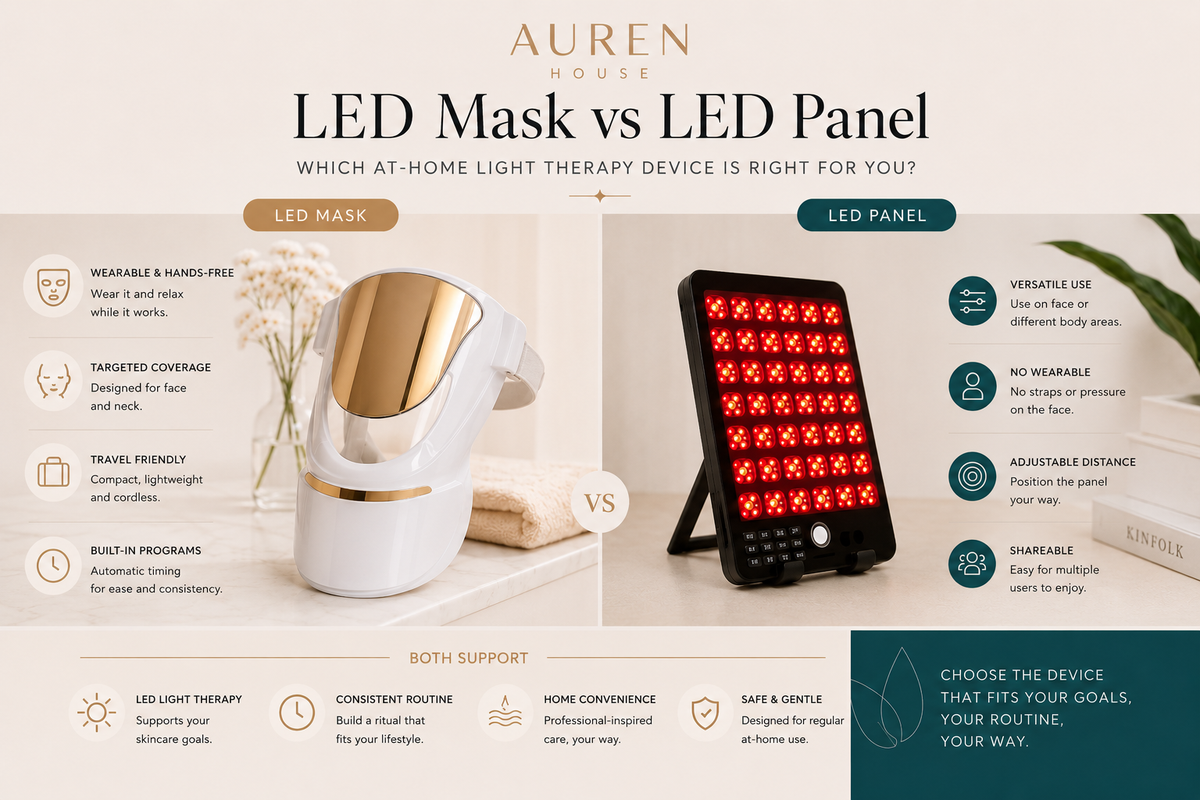
LED Mask vs LED Panel: Which At-Home Device Is Right for You?
Choosing an at-home LED device is not simply a matter of asking which product is “more powerful”.
The more useful question is:
Which format are you most likely to use correctly and consistently?
LED masks and panels may use similar wavelengths, but their design, coverage and place within your routine can be very different.
Quick comparison
| Consideration | LED Mask | LED Panel |
|---|---|---|
| Main treatment area | Face, sometimes neck | Face or targeted body areas |
| Worn on the skin | Yes | No |
| Hands-free | Usually | Often, with a stand |
| Facial pressure | Some contact or strap pressure | No direct contact |
| Movement during use | More freedom with rechargeable models | Usually remain positioned nearby |
| Portability | Often easier to carry | Depends on panel size |
| Treatment distance | Fixed or close to skin | Must be positioned correctly |
| Sharing between users | Requires careful cleaning | Easier without facial contact |
| Best suited to | Dedicated facial routines | Flexible or targeted light care |
Neither format is automatically better. The strongest choice depends on comfort, treatment goals and the device’s verified specifications.
What is an LED mask?
An LED mask is shaped to distribute light around the facial contours. Some devices also include a neck panel.
Its main advantage is convenience. Once positioned, the customer can often complete a session without holding the device.
An LED mask may suit you if:
- You mainly want facial coverage
- You prefer a wearable device
- You want a fixed treatment distance
- You value hands-free use
- You want to move around or relax during a session
- You prefer one device covering the face and neck
Potential disadvantages
- Some masks feel heavy or restrictive
- Straps can affect comfort
- Eye openings vary between designs
- Fit may not be identical for every face
- Cleaning requires attention because the device contacts the skin
What is an LED panel?
An LED panel sits in front of the treatment area rather than being worn.
Portable panels commonly include a stand, while larger panels or canopies may be positioned over the face or body.
An LED panel may suit you if:
- You dislike wearing facial masks
- You want contact-free sessions
- You want to use the device on different areas
- Multiple people may use the device
- You prefer adjustable positioning
- You want the option of face or body care
Potential disadvantages
- You may need to remain in one position
- Treatment distance must be measured correctly
- Light can spill into the surrounding area
- Eye protection may be required
- Larger panels are less travel-friendly
Does an LED mask work better because it is closer?
Not necessarily.
Distance is only one part of the treatment equation. Light dose also depends on:
- Irradiance
- Wavelength
- Session length
- Beam distribution
- Angle
- Coverage
- Device design
Photobiomodulation research uses carefully defined treatment parameters. This is why comparing products solely by appearance, LED count or closeness to the skin is unreliable.
A well-documented panel could potentially provide more meaningful output than a poorly documented mask—and the reverse could also be true.
Which option is more comfortable?
This is subjective.
Masks provide:
- Fixed positioning
- Wearable convenience
- Facial coverage without manual adjustment
Panels provide:
- No straps
- No facial pressure
- More distance from the eyes and skin
- Greater flexibility in treatment area
Customers prone to feeling confined may prefer a panel. Customers who want to read or move around may prefer a rechargeable mask with a viewable visor.
Which option provides better coverage?
For face-only use, a properly fitting mask can offer convenient coverage around the facial contours.
A panel may provide broader, flatter illumination but requires the face to remain correctly positioned. Some panels can also be used on the neck, chest, shoulders or other targeted areas, provided the instructions permit it.
The number of LEDs alone does not confirm even coverage. Distribution, angle and output are equally important.
Which is better for the neck?
A mask with a detachable neck panel offers a straightforward combined ritual.
A standard facial panel can also be repositioned towards the neck, but the customer must follow the recommended distance and exposure time.
Avoid pointing any electrical beauty device directly over the thyroid area unless the manufacturer’s safety information clearly permits that use.
Which is easier to use consistently?
Choose based on your actual routine rather than an ideal version of it.
Choose a mask when:
- You want to put it on and continue relaxing
- Your primary focus is face and neck care
- You prefer a structured automatic programme
- Storage space is limited
Choose a panel when:
- You dislike wearing devices
- You want several treatment positions
- You want to use it for face and targeted body areas
- You prefer contact-free care
Consistency does not make an unsuitable or undocumented device effective, but complicated routines are more likely to be abandoned.
LED mask vs LED panel vs salon appointments
| Experience | LED Mask | LED Panel | Professional Appointment |
|---|---|---|---|
| Used at home | Yes | Yes | No |
| Appointment required | No | No | Yes |
| Professional assessment | No | No | Usually |
| Treatment parameters | Device dependent | Device dependent | Practitioner controlled |
| Repeated travel required | No | No | Usually |
| One-time device purchase | Yes | Yes | Normally recurring fees |
| Best for | Routine convenience | Flexible coverage | Professional-led treatment |
An at-home product should not be described as delivering salon-equivalent results unless that claim has been specifically substantiated.
What should both devices clearly disclose?
Whether you choose a mask or panel, look for:
- Exact wavelengths
- Irradiance or light output
- Recommended distance
- Session length
- Recommended frequency
- Eye-safety guidance
- Contraindications
- Cleaning instructions
- Warranty
- Conformity documentation
- Clear customer support
The AAD advises consumers to take precautions when selecting at-home red-light devices and notes that suitability and outcomes vary.
Frequently asked questions
Is an LED panel stronger than a mask?
Not automatically. Strength cannot be assessed from size alone. Review output, wavelength, distance and treatment dose.
Do I need protective goggles?
Follow the instructions for the exact device. Panels may expose the eyes to more surrounding light, while masks use different eye-opening and shielding designs.
Can I use a panel on my body?
Only where the product instructions explicitly allow body use.
Is a panel more hygienic?
It can involve less skin contact, but the device and shared surroundings should still be kept clean.
Can I use a mask and panel together?
Using multiple devices does not automatically improve results and may increase exposure beyond the recommended treatment dose. Follow one clear routine unless professionally advised otherwise.
The final decision
Choose the LED mask when you want a dedicated, hands-free facial ritual.
Choose the LED panel when you want contact-free use and greater flexibility across different treatment areas.
Choose the LED canopy when you want broader face or body coverage and have more space for a larger device.
The best product is not the one with the loudest claims. It is the one with credible specifications, clear instructions and a design that fits your life.
Prefer a wearable face and neck ritual?
Explore the Auren LumiForm.
Prefer flexible, contact-free light care?
Explore the Auren LumiCast.


