
LED Face Masks: What They Do, How to Use One and What to Expect
LED face masks may look futuristic, but their appeal is surprisingly simple: they allow you to introduce focused light-led care into your routine without booking another appointment.
For customers with busy schedules, the real benefit is not simply the number of LEDs or light settings. It is being able to create a consistent skincare ritual at home.
However, not every mask is identical, and not every claim made about LED light therapy is supported by evidence. Understanding the technology, specifications and limitations will help you make a more informed decision.
What is an LED face mask?
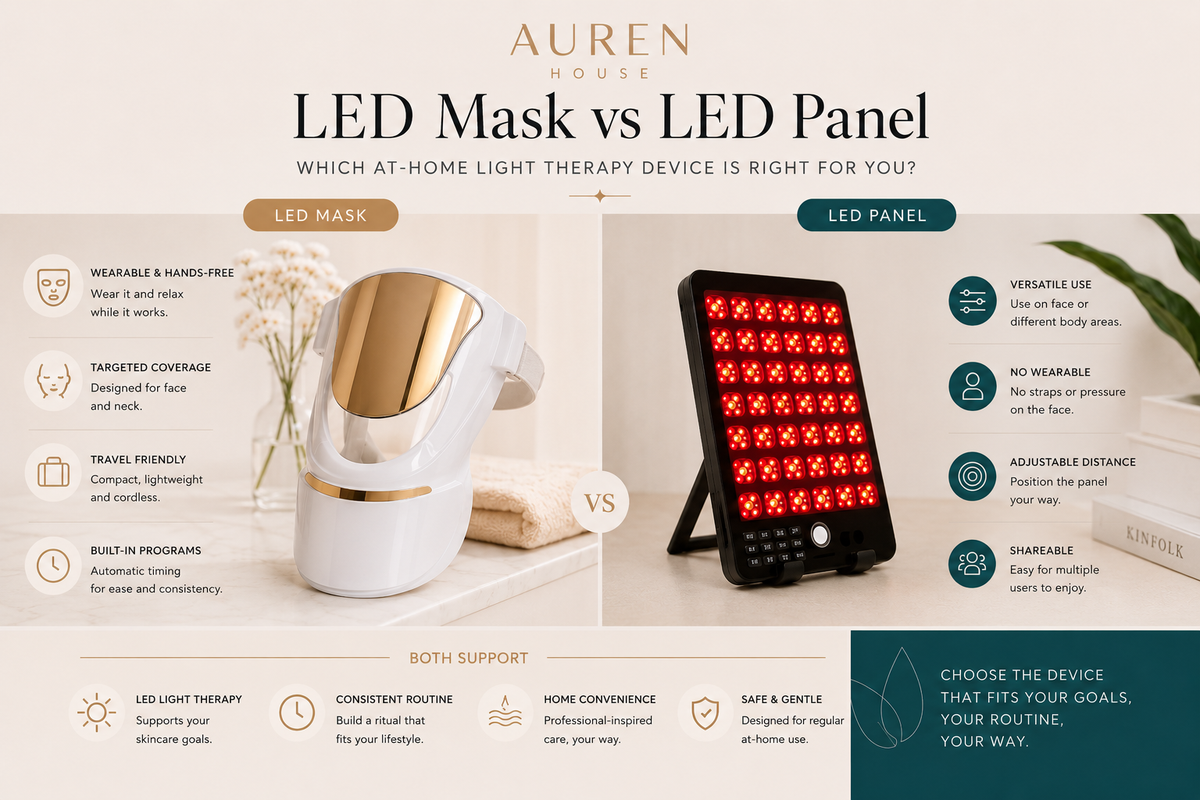
An LED face mask is a wearable beauty device that distributes specific wavelengths of light across the skin.
This type of light treatment is often described as photobiomodulation. The potential effect depends on several factors, including:
- Wavelength
- Light intensity
- Energy dose
- Distance from the skin
- Session duration
- Frequency of use
- The design of the exact device
This matters because research performed using one mask cannot automatically prove that every LED mask will produce the same result. For example, a 2023 facial study used a specific 630nm red-light mask, a defined energy dose and 12-minute sessions twice per week for 3 months. Those results relate to that treatment protocol rather than every red-light product on the market.
What are the potential benefits of an LED face mask?
Red and near-infrared light have been studied in relation to the appearance of facial ageing, skin texture and photobiomodulation. Research is encouraging, but devices and study protocols vary considerably.
For a cosmetic beauty brand, the most responsible way to describe an at-home LED ritual is that it may support:
- Brighter-looking skin
- A smoother-looking complexion
- A firmer-looking appearance
- Skin that appears more refreshed
- A more consistent skincare routine
The American Academy of Dermatology explains that results from red-light devices can range from subtle to noticeable and that the outcome depends partly on the device and treatment plan. It also notes that long-term safety data remain limited.
An LED mask should therefore be viewed as a consistent beauty ritual—not an instant transformation.
What do the different LED light colours mean?
Red light
Red light is one of the most widely researched wavelengths within cosmetic photobiomodulation.
It is commonly used in routines focused on:
- Smoother-looking skin
- A firmer-looking appearance
- Visible signs of tiredness
- Overall skin luminosity
The exact wavelength, output and treatment dose remain important. A mask advertising “red light” without explaining its specifications gives the customer very little meaningful information.
Near-infrared light
Near-infrared light is not normally visible to the human eye. It is often combined with red light in photobiomodulation devices.
It should not be assumed that a stronger-looking glow means a stronger treatment. Near-infrared output must be assessed through technical documentation rather than appearance alone.
Blue light
Blue light has been researched in dermatological settings, including acne-related applications. However, advertising that a home LED mask treats, prevents or removes acne may constitute a medicinal claim in the UK. That requires appropriate evidence, conformity status and regulatory compliance for the exact device.
A cosmetic product page should not casually promise to:
- Kill acne bacteria
- Cure breakouts
- Treat rosacea
- Remove inflammation
- Heal a skin condition
Other colours
Some masks include orange, yellow, green, cyan, purple or white settings.
There is research into different wavelengths, but the presence of several colours does not prove that each setting produces a separate clinical outcome. A responsible brand should explain only what can be supported for the exact product.
How do you use an LED face mask?
Always follow the instructions supplied with your exact device. A typical routine may look like this:
- Cleanse your skin and remove makeup.
- Dry the face completely.
- Position the mask and adjust the straps.
- Use any required eye protection.
- Select the appropriate setting.
- Complete the recommended session.
- Remove and clean the mask.
- Continue with your usual skincare if permitted by the instructions.
Do not automatically assume that applying serum beneath the mask will improve results. Some formulas may affect comfort, light transmission or device cleanliness. Follow the manufacturer’s guidance rather than advice written for another product.
The American Academy of Dermatology recommends speaking with a dermatologist before starting at-home red-light treatment, particularly where a customer has an existing condition, sensitivity or uncertainty about whether the treatment is suitable.
How often should you use an LED mask?
There is no universal schedule that applies to every device.
Some research protocols use 2 sessions each week, while others use 3. Session length and energy dose also vary.
The correct routine should come from:
- The exact device manual
- Product-specific testing
- Its wavelengths and output
- The recommended treatment dose
- Individual suitability
Using a mask more often than instructed does not necessarily produce faster results.
What should you realistically expect?
LED beauty devices are not overnight fixes.
A realistic expectation is that visible changes, where experienced, are associated with repeated use over time. Results can vary according to:
- Age
- Skin condition
- Device specifications
- Routine consistency
- Other skincare products
- Lifestyle and sun exposure
This is why before-and-after promises such as “wrinkles removed in 7 days” should be treated cautiously unless the advertiser can show robust evidence for the exact device and treatment protocol.
How to choose an LED face mask
Look beyond the number of colours and consider:
Verified wavelengths
The product should clearly state the wavelengths used rather than merely saying “red” or “blue”.
Light output
Irradiance or power density helps explain how much light reaches the treatment area.
Treatment time
A device that fits comfortably into your routine may be easier to use consistently.
Comfort and fit
Consider weight, straps, eye comfort, ventilation and whether the mask covers the neck.
Safety information
The product should include understandable warnings, contraindications and usage instructions.
Documentation and support
A credible seller should offer more than a product image. Look for clear specifications, customer support, warranty information and realistic claims.
LED face mask FAQs
Can I use an LED face mask every day?
Only use it as frequently as the exact device instructions recommend. Daily use is not automatically appropriate for every mask.
Should I use skincare underneath the mask?
Follow the device instructions. Starting with clean, dry skin is generally the simplest approach unless the manufacturer specifies otherwise.
Does an LED mask replace professional treatment?
No. An at-home mask can offer convenience and consistency, but it should not be presented as equivalent to a professional treatment unless that comparison has been properly demonstrated.
Are LED face masks safe?
Short-term use of red-light devices appears generally well tolerated, but mild irritation or discomfort can occur, and long-term evidence remains limited. Suitability also depends on the device and the individual.
Does an LED mask treat acne?
Do not assume that a cosmetic mask is authorised to treat acne. In the UK, acne-treatment claims can be medicinal claims requiring appropriate evidence and regulatory status.
A more considered light ritual
The right LED mask is not necessarily the one with the most settings or the boldest claims.
It is the device you understand, feel comfortable using and can realistically make part of your routine.
Auren House approaches light-led skincare with clear guidance, realistic expectations and products designed to fit around real life.

